


Introduction
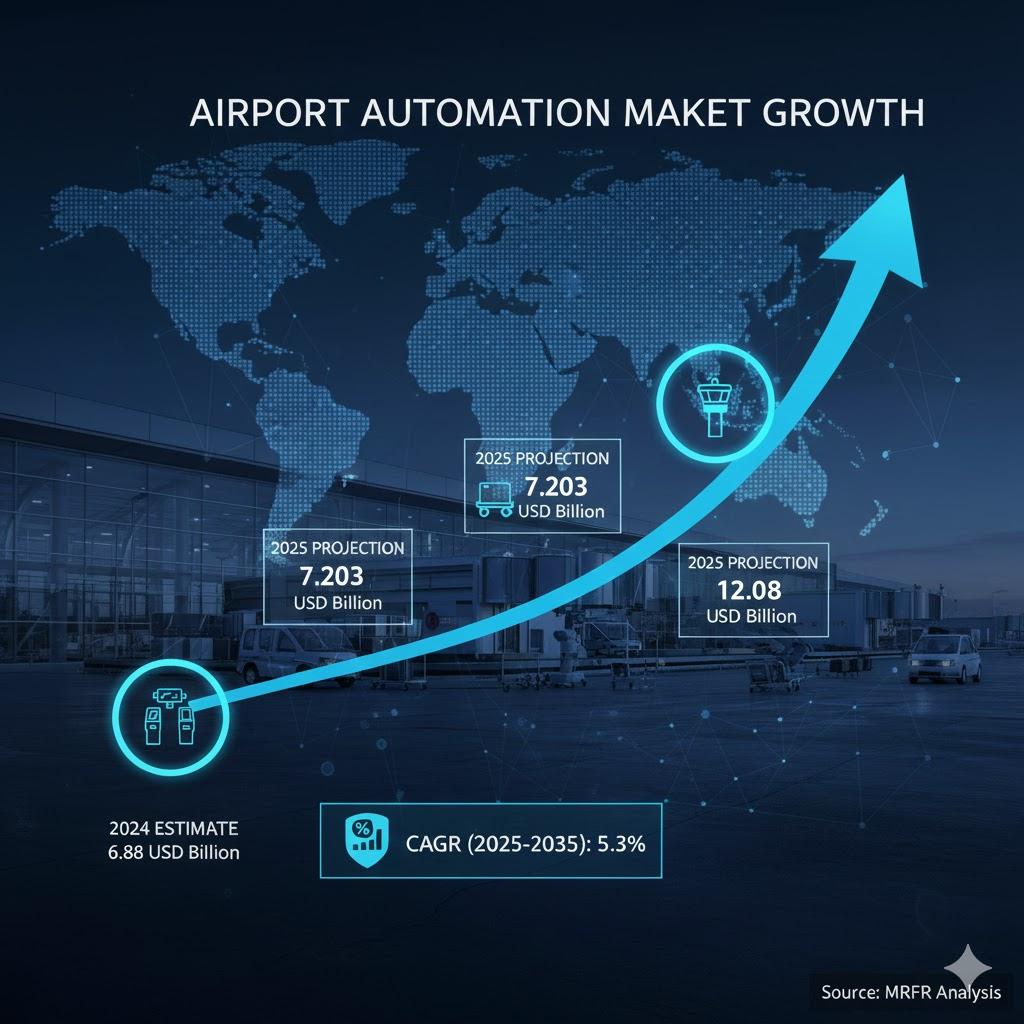
As per Market Research Future analysis, the Airport Automation Market Size was estimated at 6.84 USD Billion in 2024. The Airport Automation industry is projected to grow from 7.203 USD Billion in 2025 to 12.07 USD Billion by 2035, exhibiting a compound annual growth rate (CAGR) of 5.3% during the forecast period 2025 - 2035.
Airport automation is transforming the aviation sector by integrating advanced technologies into airport operations. Automation reduces operational bottlenecks, improves passenger experience, and enhances airport security. Airports in Europe, North America, and Asia-Pacific are increasingly investing in automated systems to manage high passenger traffic efficiently and safely.
Market Growth and Trends
The growth of the airport automation market is driven by rising passenger traffic, airline operational efficiency demands, and regulatory pressures for enhanced safety. Key trends include:
-
Self-service kiosks: Passengers increasingly prefer self-check-in and bag-drop kiosks, reducing wait times.
-
Biometric identification: Automated facial recognition and fingerprint systems improve security and passenger throughput.
-
Baggage handling automation: Advanced conveyor and sorting systems streamline luggage management.
-
AI & IoT integration: Airports are adopting AI-driven predictive maintenance and IoT-based operational monitoring.
Digital transformation and smart airport initiatives are pushing the market forward. Airports are leveraging automation to reduce human errors, optimize resource allocation, and enhance real-time decision-making.
Key Players
The airport automation market is moderately competitive, featuring global technology providers and specialized regional players. Leading companies include:
-
Honeywell International Inc.
-
Siemens AG
-
SITA
-
Amadeus IT Group
-
Vanderlande Industries
-
Thales Group
These players focus on R&D for integrated solutions, system upgrades, and technology-driven operational efficiency.
Future Scope
The future of airport automation is promising, with opportunities in:
-
Fully automated terminals for passenger and baggage management
-
AI-powered predictive analytics for operational decision-making
-
Autonomous ground vehicles for cargo and passenger transport
-
Biometric and contactless technologies for seamless airport experience
Government investments and public-private partnerships will also accelerate adoption, making airports safer, faster, and more energy-efficient.
FAQs
Q1: What is driving the airport automation market?
Increasing passenger traffic, operational efficiency needs, and technological advancements are major drivers.
Q2: Which segments are most automated?
Passenger processing, baggage handling, security, and parking management.
Q3: How is AI used in airport automation?
AI enables predictive maintenance, resource allocation, and real-time monitoring.
Discover More Research Reports on Aerospace & Defense By Market Research Future:
Aerospace Helmet Mounted display Market

 English
 Arabic
 French
 Spanish
 Portuguese
 Turkish
 Dutch
Dutch
 Italiano
 Russian
 Romaian
 Portuguese (Brazil)
 Tiếng Việt