


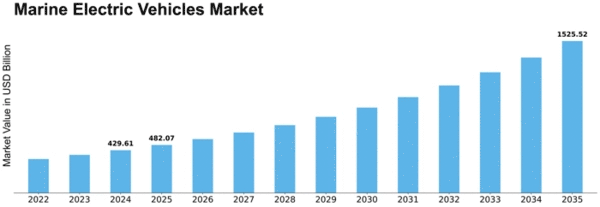
As per MRFR analysis, the Marine Electric Vehicles Market was estimated at 429.61 USD Billion in 2024. The Marine Electric Vehicles industry is projected to grow from 482.06 USD Billion in 2025 to 1525.52 USD Billion by 2035, exhibiting a compound annual growth rate (CAGR) of 12.21 during the forecast period 2025 - 2035.
Introduction
Marine electric vehicles are unlocking new opportunities across diverse maritime segments, including commercial transport, leisure boating, and autonomous marine systems. As electrification technologies mature, electric vessels are becoming viable across a wider range of applications, transforming the global marine mobility landscape.
Market Growth and Trends
The leisure boating segment is witnessing strong demand for electric propulsion due to its quiet operation, ease of maintenance, and environmental benefits. Electric yachts, sailboats, and recreational crafts are gaining popularity among environmentally conscious consumers and tourism operators.
In commercial operations, electric vessels are increasingly deployed for passenger ferries, workboats, and offshore support services. The predictable operating patterns of these vessels make them ideal candidates for electrification.
Autonomous marine vehicles represent a fast-growing segment within the market. Electric propulsion is well-suited for unmanned systems due to its efficiency, reliability, and compatibility with advanced control systems. These vehicles are widely used in oceanographic research, seabed mapping, and maritime surveillance.
Key Players
Market players are focusing on segment-specific solutions to address varying operational requirements. Leisure-focused manufacturers prioritize design, comfort, and battery efficiency, while commercial players emphasize durability, scalability, and integration with port infrastructure.
Technology companies specializing in autonomy and artificial intelligence are entering the marine electric vehicles market, forming partnerships with shipbuilders and defense agencies. These collaborations are driving innovation in autonomous navigation, energy optimization, and fleet management.
Future Scope
The future scope of the market includes expanded adoption of electric vessels in tourism and coastal transport. Governments are expected to support electrification through subsidies, tax incentives, and infrastructure investments.
Autonomous electric fleets will play a critical role in maritime logistics, environmental monitoring, and security operations. Continued innovation in battery chemistry and power electronics will further enhance vessel range and performance.
As sustainability becomes a core business priority, marine electric vehicles will emerge as a standard solution across commercial and leisure maritime segments.
FAQ
Q1. Which segments offer the highest growth potential?
Autonomous systems, passenger ferries, and leisure boats.
Q2. Why is electric propulsion ideal for leisure vessels?
It offers silent operation, low maintenance, and zero emissions.
Q3. How do autonomous vehicles benefit from electrification?
Electric systems provide efficiency, reliability, and precise control.
Q4. Are governments supporting electric marine adoption?
Yes, through incentives and infrastructure development.
Q5. What role does innovation play?
Innovation drives range improvement, cost reduction, and scalability.
Discover More Research Reports on Aerospace & Defense By Market Research Future
Electronically Scanned Array Market
Aircraft Survivability Equipment Market

 English
 Arabic
 French
 Spanish
 Portuguese
 Deutsch
 Turkish
 Dutch
Dutch
 Italiano
 Russian
 Romaian
 Portuguese (Brazil)