


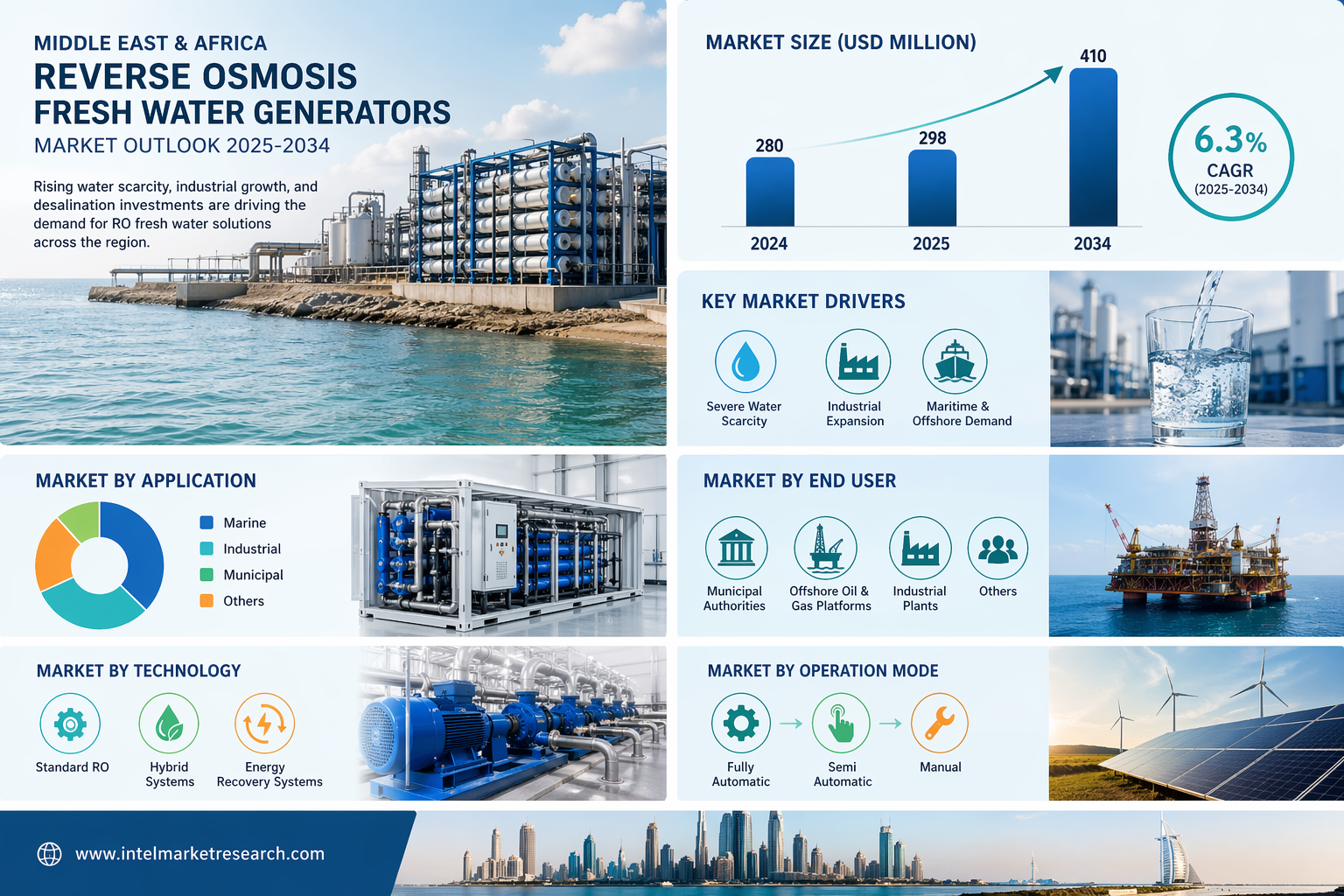
According to a new report from Intel Market Research, the Middle East & Africa Reverse Osmosis Fresh Water Generators market was valued at USD 280 million in 2024 and is projected to grow from USD 298 million in 2025 to USD 410 million by 2034, exhibiting a CAGR of 6.3% during the forecast period (2025–2034). This growth is propelled by extreme water scarcity affecting over 2 billion people in water-stressed areas, massive desalination investments in Gulf countries, and rising demand from maritime and industrial sectors.
What is Reverse Osmosis Fresh Water Generator?
Reverse Osmosis Fresh Water Generators are devices that utilize reverse osmosis (RO) technology to extract fresh water from seawater or brackish water. This process involves applying pressure to force water through a semipermeable membrane, effectively removing salts, minerals, and other impurities to produce potable or industrial-grade water. These systems are critical for marine vessels, remote installations, and regions facing acute water scarcity like the Middle East and Africa.
This report provides a deep insight into the Middle East & Africa Reverse Osmosis Fresh Water Generators market covering all its essential aspects-from a macro overview of the market to micro details such as market size, competitive landscape, development trends, niche markets, key drivers and challenges, SWOT analysis, and value chain analysis.
The analysis helps the reader understand competition within the industry and strategies for enhancing profitability. Furthermore, it provides a framework for evaluating and accessing the position of a business organization. The report also focuses on the competitive landscape of the Middle East & Africa Reverse Osmosis Fresh Water Generators Market, introducing market share, performance, product positioning, and operational insights of major players. This helps industry professionals identify key competitors and understand the competition pattern.
In short, this report is a must-read for industry players, investors, researchers, consultants, business strategists, and all those planning to foray into the Middle East & Africa Reverse Osmosis Fresh Water Generators market.
📥 Download FREE Sample Report: Middle East & Africa Reverse Osmosis Fresh Water Generators Market - View in Detailed Research Report
Key Market Drivers
1. Intensifying Water Scarcity and Infrastructure Demands
The Middle East & Africa region faces profound water stress, with several countries having among the lowest per capita freshwater availability globally. This chronic scarcity is a primary catalyst for market growth. Governments are investing heavily in desalination infrastructure to secure potable water supplies for growing urban populations, industrial activities, and agricultural needs, making reverse osmosis the dominant technological solution.
2. Expansion of Industrial and Tourism Sectors
Rapid industrialization, particularly in the GCC and North Africa, and the robust growth of the tourism and hospitality sectors create sustained demand for reliable, high-purity water. Industries such as oil & gas, power generation, and pharmaceuticals require process water, while luxury resorts and urban developments depend on reverse osmosis systems for a consistent supply, driving market growth.
➤ Technological advancements leading to higher energy recovery and lower operational costs are making large-scale RO plants more economically viable, accelerating adoption.
Furthermore, supportive government policies, subsidies for desalination projects, and increasing public-private partnerships are providing significant financial and regulatory tailwinds for the market's expansion across the region.
Market Challenges
- High Operational Costs and Energy Dependency – A core challenge is the significant energy consumption of RO processes, which ties water production costs to volatile energy prices. Despite efficiency gains, the high capital expenditure for plant construction and the ongoing costs for membrane replacement, maintenance, and skilled personnel present substantial economic hurdles for wider deployment.
- Brine Disposal and Environmental Compliance – The concentrated brine byproduct from desalination poses a major environmental challenge. Strictening regulations on brine discharge into marine ecosystems require expensive treatment or zero-liquid-discharge solutions, adding complexity and cost to operations.
- Technical and Logistical Complexities – Supplying parts, membranes, and chemicals to remote or landlocked locations in Africa increases logistical costs and downtime. Furthermore, sourcing and retaining technically skilled operators for advanced RO systems remains a persistent issue for many projects.
Emerging Opportunities
The regional landscape is becoming increasingly favorable for desalination technology adoption and commercialization. Growing infrastructure needs, supportive policy frameworks, and strategic industry collaborations are accelerating market expansion across the Middle East & Africa. Key growth enablers include:
- Decentralized and Containerized RO Systems – A significant opportunity lies in the growing demand for modular, containerized, and mobile reverse osmosis units ideal for remote communities, military bases, mining sites, and disaster relief operations.
- Integration with Renewable Energy – Coupling RO plants with solar or wind power presents a transformative opportunity to mitigate energy costs, promising to reduce the carbon footprint and operational expenses, especially in sun-rich regions.
- Adoption in Emerging Industrial Corridors – The development of new economic zones, smart cities, and industrial corridors creates a direct pipeline for new RO generator installations mandating sustainable water solutions.
Collectively, these factors are expected to enhance accessibility, stimulate innovation, and drive penetration across new applications and sub-regions.
📥 Download FREE Sample Report: Middle East & Africa Reverse Osmosis Fresh Water Generators Market - View in Detailed Research Report
Regional Market Insights
- Middle East: Leads the market driven by chronic water scarcity and aggressive desalination initiatives across Gulf nations. Arid climates and booming populations spur adoption, particularly in maritime and industrial sectors. UAE, Saudi Arabia, and Qatar prioritize sustainable solutions in mega-projects like NEOM.
- North Africa: Exhibits steady growth propelled by Mediterranean desalination in Egypt, Algeria, and Morocco. Water stress from agriculture and tourism drives RO adoption to augment supplies.
- East Africa: Emerges as promising with coastal nations like Kenya and Tanzania tackling deficits amid population booms. Port expansions boost usage in vessels and resorts.
- West Africa: Shows nascent expansion centered on Nigeria and Ghana's offshore oil and urban needs. RO supports remote rigs and coastal communities.
- Southern Africa: Contributes through South Africa's advanced efforts and mining demands. Cape Town's crisis accelerates infrastructure integrating RO with recycling.
Market Segmentation
By Type
- Small-scale
- Large-scale
By Application
- Marine
- Industrial
- Municipal
- Others
By End User
- Municipal Authorities
- Offshore Oil & Gas Platforms
- Industrial Plants
By Technology
- Standard RO
- Hybrid Systems
- Energy Recovery Systems
By Operation Mode
- Fully Automatic
- Semi-Automatic
- Manual
📘 Get Full Report Here: Middle East & Africa Reverse Osmosis Fresh Water Generators Market - View Detailed Research Report
Competitive Landscape
While Wärtsilä and Alfa Laval dominate the current market, several global and niche firms are strengthening their positions through energy-efficient systems tailored for high-salinity environments and extreme climates.
The report provides in-depth competitive profiling of 14+ key players, including:
- Wärtsilä
- Alfa Laval
- Tecnicomar
- Hatenboer-Water
- ROCHEM
- Pall Corporation
- GEFICO
- IMS Group (Jowa)
- Evac Group
- IDE Technologies
- Veolia Water Technologies
- Doosan Heavy Industries
- Acciona Agua
- HANSUN
Report Deliverables
- Regional market forecasts from 2025 to 2034
- Strategic insights into technological advancements, infrastructure projects, and regulatory developments
- Market share analysis and SWOT assessments
- Pricing trends and operational dynamics
- Comprehensive segmentation by type, application, end user, technology, operation mode, and sub-regions
📘 Get Full Report Here: Middle East & Africa Reverse Osmosis Fresh Water Generators Market - View Detailed Research Report
📥 Download FREE Sample Report: Middle East & Africa Reverse Osmosis Fresh Water Generators Market - View in Detailed Research Report
About Intel Market Research
Intel Market Research is a leading provider of strategic intelligence, offering actionable insights in biotechnology, pharmaceuticals, and healthcare infrastructure. Our research capabilities include:
- Real-time competitive benchmarking
- Global clinical trial pipeline monitoring
- Country-specific regulatory and pricing analysis
- Over 500+ healthcare reports annually
Trusted by Fortune 500 companies, our insights empower decision-makers to drive innovation with confidence.
🌐 Website: https://www.intelmarketresearch.com
📞 Asia-Pacific: +91 9169164321
🔗 LinkedIn: Follow Us

 English
 Arabic
 French
 Spanish
 Deutsch
 Turkish
 Dutch
Dutch
 Italiano
 Russian
 Romaian
 Portuguese (Brazil)
 Tiếng Việt