
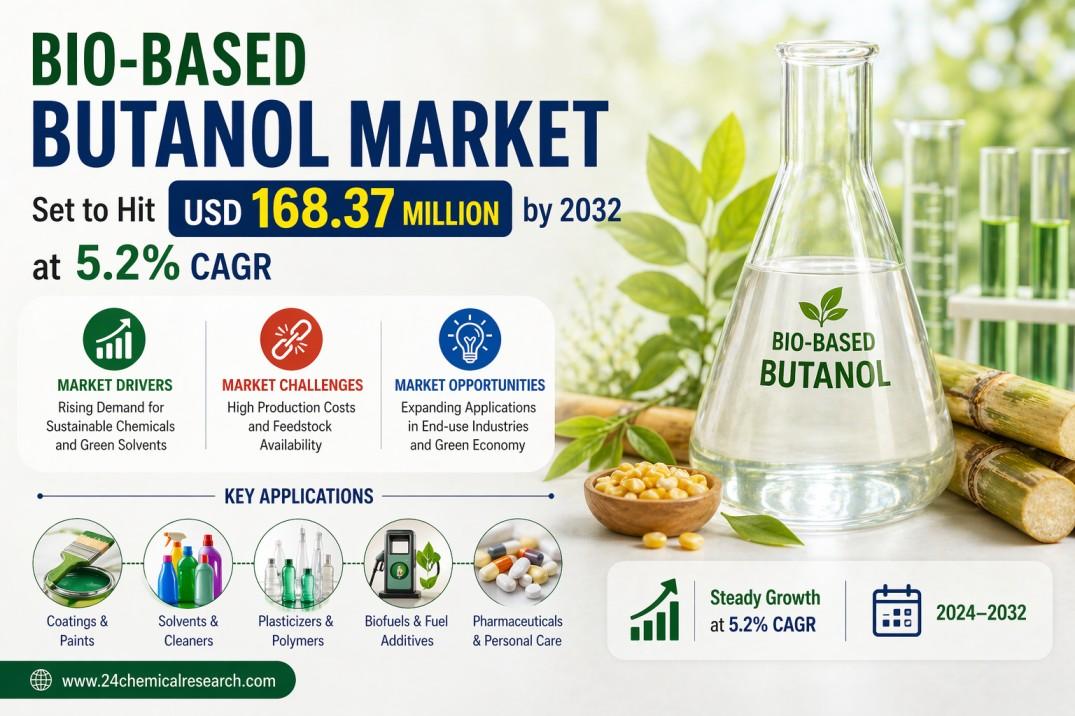
Global bio-based butanol market size was valued at USD 105.82 million in 2024. The market is projected to grow from USD 112.45 million in 2025 to USD 168.37 million by 2032, exhibiting a CAGR of 5.2% during the forecast period.
Bio-based butanol (biobutanol), a sustainable alternative to petroleum-based butanol, is gaining significant traction as industries transition toward eco-friendly chemical solutions. Produced from renewable biomass sources like corn, sugarcane, and agricultural waste through advanced fermentation processes, biobutanol offers comparable performance to its fossil-fuel-derived counterpart while reducing carbon footprint. Its superior energy density and compatibility with existing fuel infrastructure position it as a promising biofuel and industrial solvent.
Get Full Report Here: https://www.24chemicalresearch.com/reports/264310/global-biobased-butanol-market-2024-96
Market Dynamics:
The bio-based butanol market evolution is driven by environmental regulations, technological advancements, and shifting consumer preferences, though it faces challenges in production scalability and cost competitiveness.
Powerful Market Drivers Propelling Expansion
-
Sustainability Mandates Accelerating Adoption: Stringent global environmental regulations like the EU's Renewable Energy Directive II and California's Low Carbon Fuel Standard are compelling industries to seek renewable alternatives. Biobutanol's 50-85% lower lifecycle greenhouse gas emissions compared to conventional butanol makes it particularly attractive. The global biofuels market, valued at $120 billion in 2023, provides a substantial growth platform for biobutanol as a next-generation biofuel.
-
Enhanced Fuel Properties Driving Automotive Applications: With 25% higher energy density than ethanol and superior blending capabilities (up to 16% blends in unmodified engines versus 10% for ethanol), biobutanol is emerging as a preferred biofuel. Major automakers are conducting R&D on biobutanol blends, with preliminary tests showing 8-12% better fuel efficiency than ethanol blends in conventional internal combustion engines.
-
Industrial Solvent Demand in Green Chemistry: The $25 billion global solvents market is increasingly adopting biobutanol as a safer alternative in paints, coatings, and adhesives. Its slower evaporation rate and superior dissolving power reduce VOC emissions by 30-40% compared to petroleum-based solvents, aligning with tightening workplace safety and environmental regulations worldwide.
Download FREE Sample Report: https://www.24chemicalresearch.com/download-sample/264310/global-biobased-butanol-market-2024-96
Significant Market Restraints Challenging Adoption
Despite its potential, several factors currently limit biobutanol's market penetration.
-
High Production Costs: Current biobutanol production costs remain 20-30% higher than petroleum-based butanol, primarily due to expensive feedstock (40-60% of production costs) and energy-intensive recovery processes. While technological improvements have reduced costs from $4.5/gallon to $3.2/gallon since 2018, further reductions are needed to achieve price parity.
-
Feedstock Availability Challenges: Competition for agricultural feedstocks with food production creates supply chain vulnerabilities. During the 2022 commodity price surges, feedstock costs increased by 35-45%, squeezing producer margins. Developing non-food feedstock sources like agricultural residues and algae is critical for long-term sustainability.
Critical Market Challenges Requiring Innovation
The industry must overcome technical and infrastructure barriers to achieve commercial viability. Yield improvements are essential - current fermentation processes convert only 20-25% of feedstock sugars to butanol, compared to 90%+ for ethanol production. Separation and purification account for 40% of production costs due to butanol's toxicity to microorganisms at concentrations above 2%.
Infrastructure limitations also pose challenges. While biobutanol is more compatible with existing pipelines than ethanol, dedicated storage and handling systems remain scarce. The lack of standardized specifications across regions further complicates international trade, with potential buyers requiring 6-12 months for product validation in their specific applications.
Vast Market Opportunities on the Horizon
-
Emerging Biochemical Applications: Biobutanol's potential as a platform chemical for producing butadiene (for synthetic rubber) and butyl acrylate (for paints) could open a $15 billion market opportunity. Recent catalyst developments have improved conversion efficiencies from 50% to 75% in pilot-scale operations.
-
Aviation Biofuel Potential: With the aviation industry committing to 10% sustainable aviation fuel (SAF) by 2030, biobutanol-derived SAF blends show promise. Test flights have demonstrated performance parity with conventional jet fuel, while lifecycle emissions reductions exceed 65%.
-
Strategic Agricultural Partnerships: Innovative partnerships between biobutanol producers and farming cooperatives are creating closed-loop systems where agricultural waste becomes feedstock. These arrangements can reduce feedstock costs by 15-20% while providing farmers with additional revenue streams.
In-Depth Segment Analysis: Where is the Growth Concentrated?
By Type:
The market segments into Bio-Based N-butanol and Bio-Based Isobutanol. Bio-Based N-butanol currently dominates due to its wide applications in solvents and plasticizers. However, Bio-Based Isobutanol is experiencing faster growth owing to its superior fuel properties and emerging use in SAF production.
By Application:
Key segments include Biofuel, Industrial Solvent, and Others. The Industrial Solvent segment leads current demand, particularly in paints and coatings. The Biofuel segment is projected to exhibit the highest growth rate as transportation sectors decarbonize, with marine and aviation applications showing particular promise.
By End-User Industry:
The market serves Automotive, Chemicals, Paints & Coatings, and Others. The Chemicals industry accounts for the largest share, utilizing biobutanol as a precursor for various derivatives. The Automotive sector is emerging as a key growth driver as OEMs explore higher bio-content fuel blends to meet sustainability targets.
Download FREE Sample Report: https://www.24chemicalresearch.com/download-sample/264310/global-biobased-butanol-market-2024-96
Competitive Landscape:
The global bio-based butanol market features moderate consolidation, with the top four players—Gevo, Cobalt Technologies, Green Biologics, and Butamax Advanced Biofuels—controlling approximately 60% of production capacity. These leaders are distinguished by proprietary fermentation technologies and strategic partnerships with agricultural and industrial players.
List of Key Bio-based Butanol Companies Profiled:
-
Gevo (U.S.)
-
Cobalt Technologies (U.S.)
-
Green Biologics (U.K.)
-
Butamax Advanced Biofuels (U.S.)
-
Cathay Industrial Biotech (China)
-
Eastman Chemical Company (U.S.)
-
Solvay (Belgium)
Competitors are focusing on metabolic engineering to improve microbial strains and developing integrated biorefineries that co-produce biobutanol with higher-value chemicals to improve economics.
Regional Analysis: A Global Footprint with Distinct Leaders
-
North America: Commands 45% market share, driven by favorable renewable fuel policies and strong R&D investment. The U.S. leads in technology development, with several demonstration-scale plants operational.
-
Europe: Accounts for 30% of demand, with stringent sustainability regulations accelerating adoption. Germany and France are at the forefront, supported by EU circular economy initiatives.
-
Asia-Pacific: Emerging as the fastest-growing region (projected 6.2% CAGR), with China and India investing in domestic production capabilities to reduce chemical import dependence.
Get Full Report Here: https://www.24chemicalresearch.com/reports/264310/global-biobased-butanol-market-2024-96
Download FREE Sample Report: https://www.24chemicalresearch.com/download-sample/264310/global-biobased-butanol-market-2024-96
About 24chemicalresearch
Founded in 2015, 24chemicalresearch has rapidly established itself as a leader in chemical market intelligence, serving clients including over 30 Fortune 500 companies. We provide data-driven insights through rigorous research methodologies, addressing key industry factors such as government policy, emerging technologies, and competitive landscapes.
-
Plant-level capacity tracking
-
Real-time price monitoring
-
Techno-economic feasibility studies
International: +1(332) 2424 294 | Asia: +91 9169162030
Website: https://www.24chemicalresearch.com/

 English
 Arabic
 French
 Portuguese
 Deutsch
 Turkish
 Dutch
Dutch
 Italiano
 Russian
 Romaian
 Portuguese (Brazil)
 Tiếng Việt