


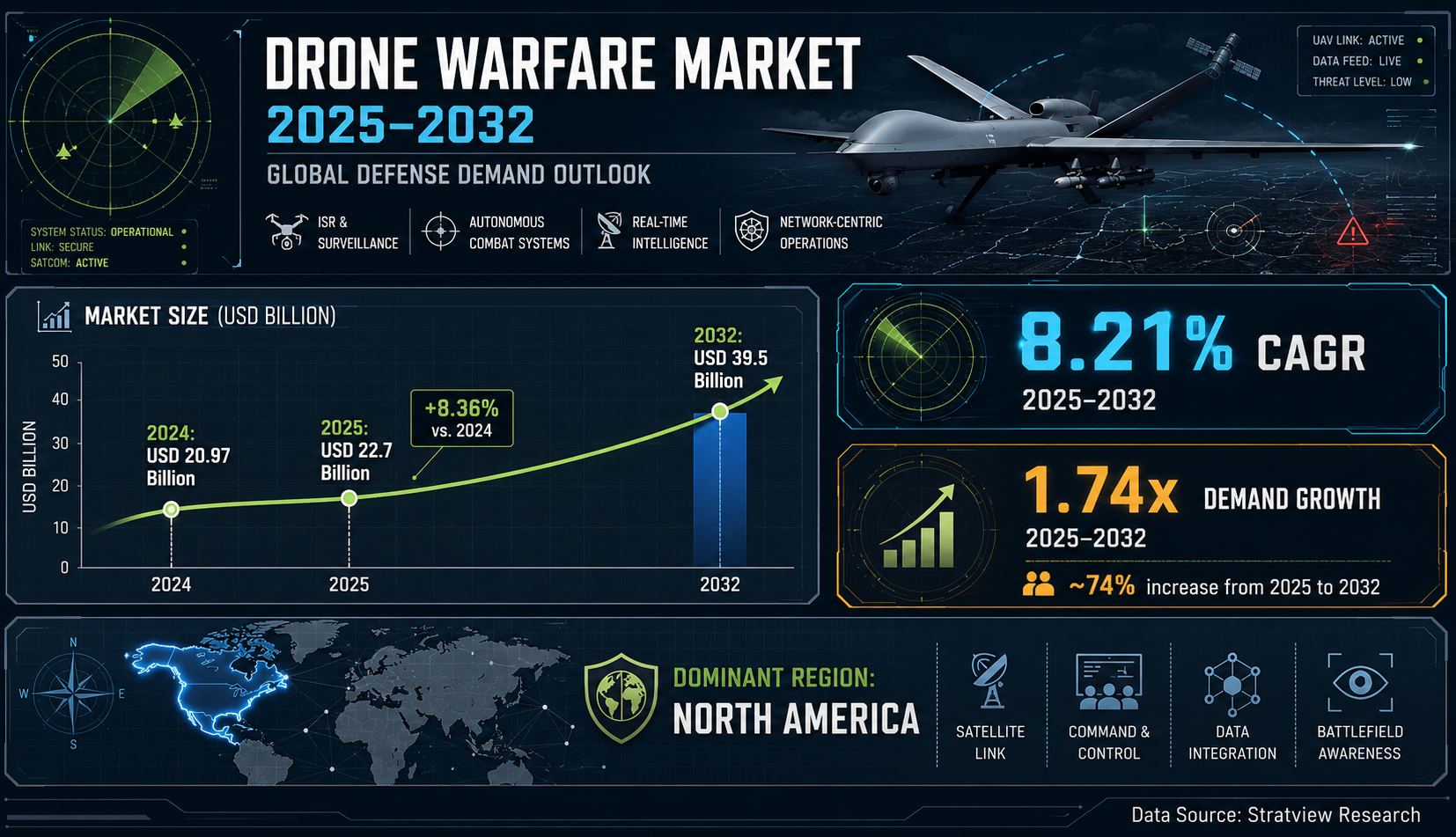
The Drone Warfare Market was valued at USD 20.97 billion in 2024 and is expected to reach USD 39.5 billion by 2032. The market is forecast to grow from USD 22.7 billion in 2025 at an 8.21% CAGR during 2025-2032, reflecting rising defense investment and military modernization priorities.
“The Drone Warfare Market is expected to grow at a CAGR of 8.21% during 2025-2032.” Demand is increasing as countries invest in unmanned aerial vehicles for surveillance, reconnaissance, target acquisition, and direct attack roles. This growth trajectory reflects the strategic value of drones in modern warfare.
Request a free sample report:
https://www.stratviewresearch.com/Request-Sample/drone-warfare-market#form
The market’s expansion is linked to surging defense budgets and the integration of advanced technologies in drones. Artificial intelligence, machine learning, and sensor technologies are improving autonomous flight, target detection, and mission planning, making drones more effective across multiple military uses.
For defense planners tracking Drone Warfare Market trends, the central signal is clear: drone systems are becoming more embedded in military operations because they support efficiency, precision, and lower-cost deployment compared with manned aircraft.
Market Segmentation Analysis
By Capability Type, the Drone Warfare Market is segmented into Platforms, Application Software, Services, Ground Control Stations, and Drone Launch & Recovery Systems. Application Software is anticipated to be the fastest-growing segment during the forecast period, driven by demand for advanced software that supports navigation, targeting, surveillance, and data collection.
By Application Type, the market is segmented into Unmanned Combat Aerial Vehicles, Intelligence, Surveillance, & Reconnaissance, and Delivery. Unmanned Combat Aerial Vehicles is expected to dominate the market with the highest growth rate during the forecast period, reflecting the increasing operational importance of unmanned systems in combat environments.
By Mode of Operation Type, the market is segmented into Semi-Autonomous and Autonomous. Autonomous is projected to lead the market with the highest growth rate during the forecast period, supported by rapid advancements in artificial intelligence and machine learning technologies that enable drones to operate independently without human intervention.
By Region, the market is segmented into North America, Europe, Asia-Pacific, and Rest of the World. This structure reflects demand across major defense regions, with growth shaped by defense budgets, modernization programs, and the adoption of advanced drone technologies.
Regional Market Insights
North America is expected to be the dominant and fastest-growing region over the forecasted period. The region’s growth is driven by growing defense budgets and a strong focus on military modernization, supported by advanced drone technologies such as AI-driven capabilities and autonomous systems.
North America’s regional demand is also supported by border security needs, counterterrorism measures, and rising geopolitical tensions. These factors strengthen the region’s position in drone deployment, systems development, and defense technology adoption.
Emerging Trends Shaping the Drone Warfare Market
The most visible trend is the rising integration of artificial intelligence, machine learning, and sensor technologies into military drones. These technologies improve autonomous flight, target detection, and mission planning, allowing drones to operate more effectively and efficiently across military applications.
Another important trend is the growing focus on autonomous operations. The autonomous segment is projected to lead the market with the highest growth rate, indicating that defense organizations are prioritizing systems capable of operating independently in missions where human control may be limiting or risky.
Electronic warfare systems, anti-air lasers, and drone-hunting drone technologies are also shaping the market direction. These technologies support counter-drone operations, protect friendly assets, and create opportunities for defense contractors to diversify offerings and pursue strategic collaborations.
Key Growth Drivers of the Market
- Rising defense budgets are increasing investment in cutting-edge defense technologies, creating stronger demand for drones as militaries recognize their strategic value in modern warfare.
- Artificial intelligence, machine learning, and sensor technologies are improving autonomous flight, target detection, and mission planning, making drones more effective across military applications.
- Drones offer cost advantages over manned aircraft because they are lighter, more fuel-efficient, require less maintenance, and reduce operator training costs.
- Network-centric warfare is increasing the role of drones within connected military systems, supporting coordination, surveillance, and operational efficiency across defense missions.
- Global conflicts and terrorist threats are increasing demand for UAV-based surveillance, reconnaissance, target acquisition, and direct attack capabilities.
Competitive Landscape
Top Companies in the Market
Northrop Grumman Corp.
Raytheon Technologies Corporation
Israel Aerospace Industries Ltd.
General Atomics Aeronautical Systems, Inc.
Teledyne FLIR LLC
Aerovironment, Inc.
Boeing
Airbus
Textron Inc.
Lockheed Martin Corporation
Elbit Systems Ltd.
Thales
Conclusion and Strategic Outlook
The Drone Warfare Market is positioned for steady expansion, rising from USD 22.7 billion in 2025 to USD 39.5 billion by 2032 at an 8.21% CAGR. Growth is supported by defense modernization, AI-enabled drone capabilities, cost advantages over manned aircraft, and expanding autonomous operations.
From a strategic market intelligence perspective, the market’s outlook reflects a shift toward integrated, software-driven, and autonomous unmanned systems. As defense organizations continue to prioritize operational efficiency and mission flexibility, drone warfare is expected to remain a key area of long-term defense technology investment.
FAQs – Drone Warfare Market
What is the Drone Warfare Market size and forecast?
The Drone Warfare Market was valued at USD 20.97 billion in 2024. It is expected to grow from USD 22.7 billion in 2025 to USD 39.5 billion by 2032.
What CAGR is expected for the Drone Warfare Market?
The Drone Warfare Market is expected to grow at a CAGR of 8.21% during 2025-2032. This reflects sustained demand for UAV systems and related military technologies.
What is driving Drone Warfare Market growth?
Growth is driven by rising defense budgets, advanced drone technologies, cost advantages over manned aircraft, network-centric warfare, and global conflicts and terrorist threats. These factors increase demand for surveillance, reconnaissance, targeting, and combat applications.
Which region leads the Drone Warfare Market?
North America is expected to be the dominant and fastest-growing region over the forecasted period. Growth is supported by defense budgets, military modernization, border security needs, and advanced drone technology development.
What are the key risks or challenges in the Drone Warfare Market?
Adverse weather conditions and payload limitations can affect drone performance. Wind, precipitation, temperature extremes, visibility issues, and limited carrying capacity can reduce flight stability, range, and mission reliability.

 English
 Arabic
 French
 Spanish
 Deutsch
 Turkish
 Dutch
Dutch
 Italiano
 Russian
 Romaian
 Portuguese (Brazil)
 Tiếng Việt