


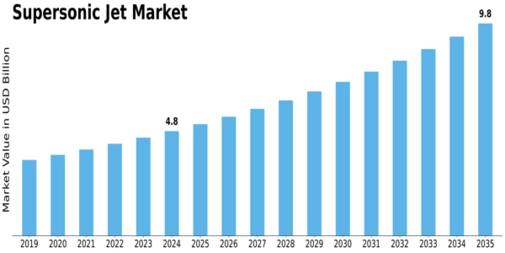
One of the most insightful ways to understand the burgeoning supersonic jet market is through its segmentation. According to the recent MRFR report, the market is analysed across application, engine type, capacity, design and region — offering a layered view of growth opportunities.
Application-based segmentation divides the market into commercial aviation, private jet travel and military aviation. Among these, commercial aviation is expected to lead in absolute size, growing to USD 4.28 billion by 2035. Private jet travel is also set to expand significantly (to USD 2.68 billion), and military applications maintain important growth (USD 2.79 billion by 2035).
Engine-type segmentation reflects how technology is unfolding: turbojet remains a mainstay for high-speed performance, turbofan is gaining attention for increased fuel and noise efficiency, and pulse detonation engines represent the frontier of supersonic propulsion. In effect, players who focus on next-generation engines may gain a competitive advantage.
Capacity segmentation reveals the breadth of the market: from ultra-luxury 1-3 passenger jets through to 4-6, and 7-10 passenger sizes, up to “more than 10 passengers” for larger commercial supersonic aircraft. This diversity shows that supersonic travel isn’t only about speed – it’s also about tailoring capacity to the use-case: VIP business travel, small-group corporate movement, or full commercial transcontinental flights.
Design segmentation – conventional wing, delta wing, flying wing – highlights the innovation in aerodynamics and aircraft architecture. Each design comes with tradeoffs in drag, stability, structural complexity and cost. The market expects all of these designs to play a role.
Regional segmentation indicates growth geography: North America is the largest and most mature market, but Europe, Asia Pacific and emerging regions like the Middle East & Africa are showing strong growth rates. For instance, Asia Pacific is projected to grow from USD 1.2 billion in 2024 to USD 2.7 billion by 2035.
For industry participants, segmentation insights are valuable: they enable targeted strategy development, allocation of R&D budgets, route/network planning for supersonic flights, and identifying which customer segments (luxury, business, commercial) to address. As the supersonic jet market evolves, companies that align with the right segment dynamics will be better positioned.
Supersonic Jet Market Set for Takeoff: Trends, Growth Drivers, and Future Outlook

 English
 Arabic
 French
 Spanish
 Portuguese
 Deutsch
 Turkish
 Dutch
Dutch
 Russian
 Romaian
 Portuguese (Brazil)
 Tiếng Việt