


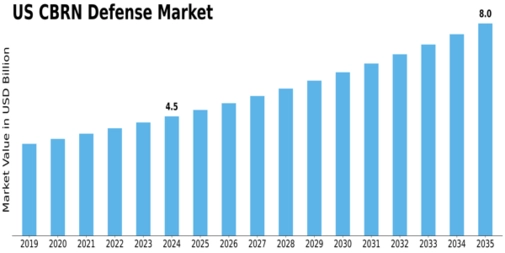
The security paradigm in the United States is shifting in response to evolving global threats, prompting renewed investment in chemical, biological, radiological, and nuclear (CBRN) defense capabilities. According to the most recent analysis by MRFR, the US CBRN Defense Market — which stood at USD 3.88 billion in 2023 — is projected to grow to USD 8.0 billion by 2035, with a CAGR of around 5.37%. This underscores a growing recognition within defense and homeland security circles that conventional military preparedness must be complemented by specialized CBRN readiness.
Driving this expansion is a convergence of rising defense budgets, technological innovation, and shifting threat perceptions. Major defense contractors — including Raytheon Technologies, General Dynamics, BAE Systems, Sierra Nevada Corporation, among others — are increasingly focusing on delivering comprehensive CBRN solutions, from advanced sensor systems and protective gear to decontamination infrastructure and integrated response tools. The shift reflects an understanding that future conflicts or security incidents may involve non-traditional hazards such as chemical attacks, bioterrorism, radiological release, or nuclear threats.
Within the domain, the chemical segment retains its dominance, driven by persistent concerns over chemical weapon use, industrial chemical accidents, and hazardous material spills. However, the biological segment is emerging as a fast-growing area amid heightened global biosecurity awareness. The radiological and nuclear segment, though smaller, remains critical due to the potential for high-impact events with severe consequences. As such, demand spans across detection & monitoring, protective wearables, decontamination solutions, and emergency response tools — portraying a multi-pronged approach to modern threat mitigation.
In addition to hardware solutions, the US market is seeing greater emphasis on preparedness infrastructure — including real-time detection networks, portable and fixed sensor systems, protective equipment, and simulation-based training for responders and military personnel. Broader analyses of global CBRN/CBRNE markets show detection and monitoring leading in demand, with protection, decontamination, and training following closely behind. This holistic approach ensures that, in the event of a CBRN incident — whether intentional or accidental — the United States has layered capabilities for detection, containment, protection, and response.
Projecting toward 2035, the expected growth of the U.S. CBRN defense market to USD 8.0 billion suggests sustained investment and strategic prioritization. As global threats diversify and the consequences of CBRN incidents become better understood, CBRN defense is likely to remain a strategic priority for the U.S. military, homeland security, and first-responder frameworks. For industry players, this evolving landscape represents an opportunity to innovate; for policymakers, it underscores the necessity of long-term commitment; and for citizens, it symbolizes enhanced national resilience against unprecedented hazards.
Related Report:
US Aircraft Towing Equipment market
US Aircraft Wires Cables market

 English
 Arabic
 French
 Spanish
 Portuguese
 Deutsch
 Turkish
 Dutch
Dutch
 Russian
 Romaian
 Portuguese (Brazil)
 Tiếng Việt