


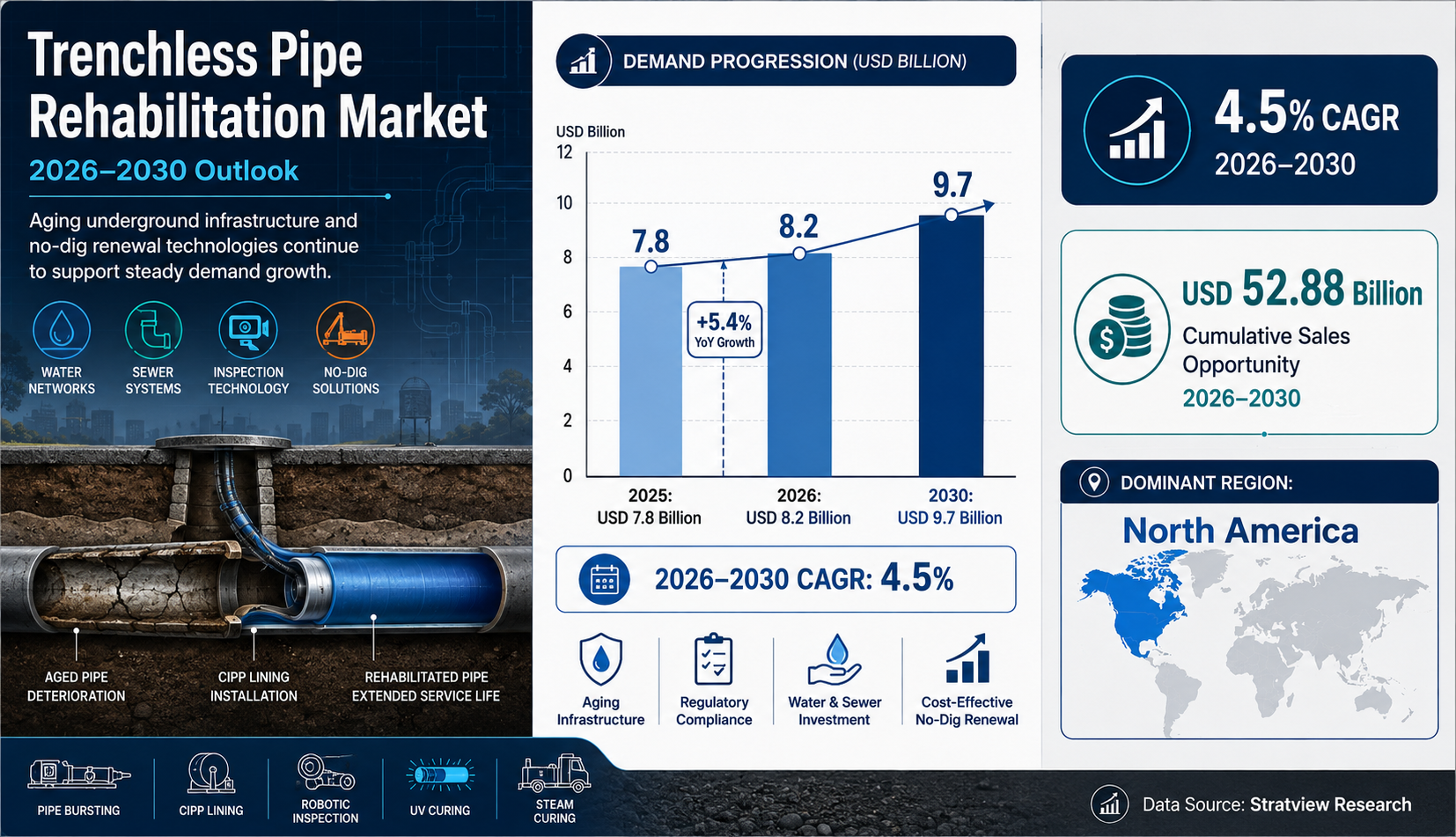
The Trenchless Pipe Rehabilitation Market was valued at USD 7.8 billion in 2025 and is forecast to reach USD 9.7 billion by 2030. The market reached USD 8.2 billion in 2026, supported by continued renewal of aging water, sewer, and wastewater pipelines. “The Trenchless Pipe Rehabilitation Market is expected to grow at a CAGR of 4.5% during 2026–2030.”
Demand is rising because municipalities, utilities, and industrial operators need repair methods that reduce excavation, traffic disruption, and environmental impact. Trenchless technologies such as cured-in-place pipe lining, pipe bursting, and slip-lining enable underground pipeline renewal with limited surface disturbance. This makes Trenchless Pipe Rehabilitation Market trends increasingly relevant for infrastructure planning.
Request a free sample report:
https://www.stratviewresearch.com/Request-Sample/trenchless-pipe-rehabilitation-market#form
Market Segmentation Analysis
The market is segmented by Application Type into Water Main Pipes, Wastewater Pipes, and Others. Wastewater Pipes are the most dominant application, whereas Water Main Pipes are growing fastest. Wastewater demand is supported by aging sewer networks in urban regions, while water main rehabilitation is linked to municipal water demand and pipeline renewal programs.
The market is segmented by Method Type into CIPP, Pipe Bursting, Slip-Lining, SIPP, and Others. CIPP remains the dominant method, whereas Pipe Bursting is projected to be the fastest-growing method during the forecast period. CIPP is widely adopted because of its installation efficiency, while pipe bursting supports replacement without extensive surface disruption.
The market is segmented by Diameter Type into <18-inch Pipes, 18-36-inch Pipes, and >36-inch Pipes. <18-inch pipes are likely to maintain their lead by 2030. These pipes represent a major portion of municipal water distribution and sewer systems, making them central to recurring rehabilitation demand.
Regional Market Insights
North America is expected to remain the dominant region during the forecast period. The region’s position is supported by advanced water infrastructure, early adoption of trenchless technologies, and sustained public and private investments in pipeline renewal. This creates a stable base for continued trenchless rehabilitation activity.
Asia-Pacific is expected to be the fastest-growing region during the forecast period. Growth is led by Japan, China, and Australia, where aging pipelines, urbanization, and government funding for water and wastewater infrastructure are accelerating trenchless rehabilitation adoption.
Emerging Trends Shaping the Trenchless Pipe Rehabilitation Market
Trenchless rehabilitation is moving from a niche repair method to a core infrastructure renewal approach. The market is being shaped by demand for lower-disruption pipeline repair, broader adoption of CIPP, rising use of pipe bursting, and increased focus on maintaining underground water and wastewater assets with fewer surface impacts.
The market’s direction reflects a practical infrastructure shift. Municipalities and utilities are increasingly selecting solutions that extend pipe life, reduce operational disruption, and address aging networks. This creates a stronger role for industry intelligence, regional analysis, and strategic insights in long-term pipeline rehabilitation planning.
Key Growth Drivers of the Market
• Aging water and wastewater pipelines increase leakage, blockage, and contamination risks, creating direct demand for rehabilitation methods that restore underground networks efficiently.
• Preference for minimal surface disruption supports trenchless methods because they reduce excavation, protect surrounding infrastructure, and limit traffic detours.
• Government and utility investments in pipeline renewal accelerate adoption by funding water loss reduction, service reliability, and environmental compliance initiatives.
• Use of durable materials and protective pipelining layers extends pipe longevity, lowering maintenance needs and improving infrastructure lifecycle performance.
• Large-scale water and sanitation infrastructure programs create opportunities for trenchless rehabilitation because pipeline construction and renewal remain core system priorities.
Competitive Landscape
Top Companies in the Market
Aegion Corporation
PURIS Corporation
Per Aarsleff A/S
SAK Construction, LLC
Reline UV Group
SAERTEX Multicom® GmbH
IMPREG Group
Ashimori Industry Co, Ltd.
Michels Corporation
Spinello Companies
Conclusion and Strategic Outlook
The Trenchless Pipe Rehabilitation Market shows a steady growth trajectory, moving from USD 7.8 billion in 2025 to USD 9.7 billion by 2030 at a CAGR of 4.5%. Demand is supported by aging pipelines, low-disruption repair needs, public infrastructure spending, and wider use of CIPP and pipe bursting technologies.
FAQs – Trenchless Pipe Rehabilitation Market
What is the size and forecast of the Trenchless Pipe Rehabilitation Market?
The Trenchless Pipe Rehabilitation Market was valued at USD 7.8 billion in 2025. It is forecast to reach USD 9.7 billion by 2030, supported by pipeline renewal demand.
What is the CAGR of the Trenchless Pipe Rehabilitation Market?
The Trenchless Pipe Rehabilitation Market is expected to grow at a CAGR of 4.5% during 2026–2030. This reflects steady demand across water, sewer, and wastewater pipeline rehabilitation.
What is driving market growth?
Growth is driven by aging pipelines, rising need for minimal surface disruption, and investment in pipeline renewal. These factors increase demand for CIPP, pipe bursting, slip-lining, and related trenchless methods.
Which regions are leading market demand?
North America is expected to remain the dominant region. Asia-Pacific is expected to be the fastest-growing region during the forecast period.
What are the key risks or challenges?
High initial capital investment is a key market challenge. Specialized equipment and skilled labor can limit adoption among smaller municipalities and utility providers.

 English
 Arabic
 French
 Spanish
 Portuguese
 Turkish
 Dutch
Dutch
 Italiano
 Russian
 Romaian
 Portuguese (Brazil)
 Tiếng Việt